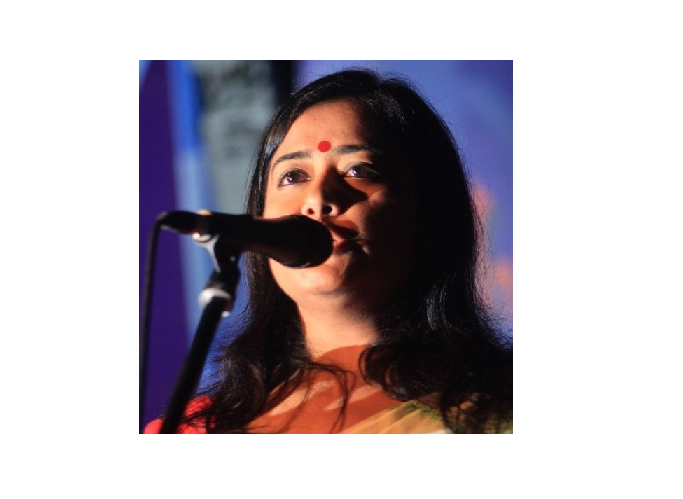
Kaberi Gayen
There has been considerable discussion on Facebook—and there will be more—to come about the use of certain words in the Bengali language. Debate is healthy. There is no doubt that the appropriate and effortless use of words borrowed from Sanskrit, Arabic, Persian, English, French, Dutch, Spanish, Japanese, Chinese or any other language can enrich a language.
But when such usage is not spontaneous, and instead comes through the imposition of a particular group, questions arise about the purpose and process of that imposition—the politics of word choice.
Let us pay a little attention to the politics of replacement.
When the same speaker uses “Inquilab Zindabad” while also saying “Joy Bangla kore diyechi” or “Joy Bangla bhore debo”, accompanied by distorted facial and visual gestures and then releases the video on YouTube, it does not take much to understand the political purpose behind the choice of words and slogans. Why is “Joy Bangla” being turned into an obscene insult while an attempt is being made to establish “Inquilab Zindabad” in its place? Why is independence or freedom being replaced by “Azadi”, and justice by “Insaf”? And who is doing this?
During the Pakistan period, there were many attempts to give the Bengali language a religious character. They did not achieve much. When we were schoolchildren, there was once an attempt to change a number of words, including replacing “jalbandh” with “panibandh”. I did not follow up on what happened afterwards. But we grew up witnessing the politics of replacing “Joy Bangla” with “Bangladesh Zindabad” and “Bangladesh Betar” with “Radio Bangladesh”.
Then came another wave from the 1990s. Words such as “byakkha” were replaced with “tafsir”, “tathyosutra” with “dohai”, and “cheshta” with “koshes”, for example. Many of those who pursued these efforts tried to identify themselves as left-wing intellectuals. Although, in many cases, I do not know which left-wing party they actually belonged to.
Over the past decade, and particularly in recent years, another wave has emerged. We now hear words such as “Azadi”, “Insaf”, “Mazlum” and “Inquilab”. Every one of these words is beautiful, and there is absolutely no problem with using them. The question is: for what purpose are they being used?
Those who did this during the Pakistan period did so in the name of Pakistan and in the interest of protecting Islam—openly and deliberately. Many of those doing it now are known for their left-wing politics. Not only do they identify themselves as leftists in this period, some of them claim to represent a higher form of leftism, while mocking the intellectual ability, competence and sacrifices of the children of historically established left-wing parties, branding them as incompetent and presenting various versions of leftism through an elaborate politics of words and slogans.
At the end of the day, some of these supposedly intellectual leftists have been gratified by receiving BNP nominations, while others have joined the NCP. When that NCP moved towards Jamaat, they formed the NPA. Around them are a number of glossy intellectuals.
What is amusing is that their arguments and language are almost identical—at least in the recent debate over language and in the politics of removing the Liberation War from its position as the central event of our history and replacing it with the status of merely one event among others.
It is therefore more reasonable to see this tendency not as the work of particular individuals but as a broader phenomenon.
Rather than focusing only on the use of particular words, it is more important to identify the broader space that is being created through the deliberate introduction of these words. Some people within this space are no longer even making an effort to conceal their communalism.
Let me give a small example.
The newly elected BNP government has appointed Nitaï Roy Chowdhury as Minister of Culture. That this appointment was inappropriate became apparent from a viral clip of Nitaï Roy Chowdhury himself. The clip may be discussed as evidence of his unsuitability for the post of Culture Minister. That discussion could, and should, have taken place.
But even before the clip became public, a fairly well-known Bengali poet launched a barrage of criticism, claiming that India had selected the minister and that India wanted to retain control over Bangladesh’s culture.
Surely this well-known person knows that India does not need to rely on a relatively weak minister to maintain cultural dominance over Bangladesh. With its music, films, television serials, fashion and IT industry enjoying a global market and influence, India hardly needs to concern itself with controlling Bangladeshi culture in that way. That influence has already penetrated virtually everything.
He knew this, yet he deliberately spread the communal insinuation because Nitaï Roy Chowdhury is Hindu. A communal marketplace quickly emerged beneath his comment.
This process is clearly communal.
Yet there could have been a discussion about Nitaï Roy Chowdhury’s suitability or otherwise as Culture Minister. There should have been. But the objective was to create a breeding ground for communalism—and he succeeded.
That is why the way words are used in constructing a narrative matters.
There is nothing wrong with criticising Nitaï Roy Chowdhury. The problem is the politics of attaching his Hindu identity to India and, through that association, making the lives of Hindus in Bangladesh more vulnerable.
In offices and institutions, it is not enough to criticise a woman’s incompetence; when her identity as a woman is attached to that alleged incompetence as a way of venting hostility, that is clearly misogyny. This is similarly a blatant form of communalism.
I saw a theoretical thinker whom I hold dear compile a list in the recent debate over language, explaining how we resonate when Kanhaïya Kumar uses the word “Azadi”, and so on.
I have absolutely no objection to these words.
I like it when Kamla Bhasin uses “Azadi”. It is as effortless a word for Kamla Bhasin as it is not for Amber.
I myself use plenty of Arabic and Persian words naturally. “Inquilab Zindabad” was once a slogan of the Communist Party of India, and it still is. I myself have sung:
“Inquilab Zindabad, the red flag,
This flag is the workers’ blood-red flag,
Pointing the way to struggle, the flag of liberation.”
The Communist Party of Bangladesh has sung this song naturally for a long time.
On the one hand, those who have spent the past eighteen months preparing the ground for attacks on Communist Party of Bangladesh offices by branding the party as an accomplice of Indian expansionism are now arranging to bring back the party’s slogan “Inquilab Zindabad” with renewed enthusiasm.
When I see the Liberation War’s battle cry “Joy Bangla” being discarded and “Inquilab Zindabad” being enthusiastically promoted in its place—and I want to draw attention to the word “anew”—I try to understand the politics behind it.
Everything associated with India is supposedly to be rejected, yet the slogan of Indian students does not appear on the list of prohibited things. This is despite the fact that the same theorists discover an Indian scent in everything and declare it unacceptable.
“Joy Bangla” and “Jiye Sindh” are slogans of the nationalist struggles of Bangladesh and Sindh respectively, emerging from the soil itself. They carry the marks of their respective ethnographic identities.
When such slogans are discarded and a slogan labelled as Indian is embraced by people who otherwise profess intense hostility towards India, it is natural to ask questions about the politics behind that choice.
This discussion should have started much earlier.
Again, let us pay attention to the politics of replacement.
When “Inquilab Zindabad” is accompanied by “Joy Bangla kore dibe” or “Joy Bangla handaiya dibe”—when the same speaker uses distorted facial gestures and uploads such videos to YouTube—it becomes difficult not to ask what political purpose lies behind these choices. Why turn “Joy Bangla” into an obscene insult while attempting to establish “Inquilab Zindabad”? Why replace independence or freedom with “Azadi”, and justice with “Insaf”? And who is making these attempts?
When a YouTube influencer who openly devoted himself to campaigning for Jamaat in this election uses the slogan “Inquilab Zindabad”, a slogan associated with Indian left-wing politics, one can close one’s eyes and return to Marshall McLuhan: “The medium is the message.”
At one time, I had a favourite curiosity about the new words added to every edition—and even every year—to the Oxford English Dictionary.
Interestingly, before my eyes I watched words such as “tikka”, “kebab” and “tandoori” enter the Oxford dictionary as these foods found their place on the British palate.
This assimilation is wonderful. New things acquire new names.
David Attenborough has described English as a sandwich of French and German, with Latin at its core. Bengali, too, developed from Sanskrit, Pali, Prakrit and Apabhramsha, while incorporating words from many foreign languages.
This assimilation is healthy.
Language is like a flowing river.
The problem lies elsewhere—in the politics of narrative construction.
The word “narrative” itself has become something of a cliché through overuse. I want to mention a small slogan: “Fikke-Kulle-Nizamin”.
I do not know what “Fikke-Kulle-Nizamin” means. I have neither affection for nor aversion to the phrase itself. I assume that ordinary students do not know its meaning either.
But it took me some time to understand why a section of a progressive student organisation used this slogan. What was achieved through that usage is meaningful.
So decode it.
Here we come to the point that the meaning of language is actually constructed according to context. Saussure wrote extensively about this.
To understand the meaning in relation to that context, one only has to calculate what this slogan added to the progressive student movement beyond causing a section of a progressive student organisation to leave and the organisation to split.
Then the underlying politics becomes clear.
I have no comment on whether the evolution of that progressive student organisation around this slogan was good or bad. But if someone uses this slogan in the future, its meaning will be constructed in relation to this context.
I call on the Facebook community to bear witness to that.
There has been considerable linguistic experimentation in Sarwar Faruqi’s television dramas and films. There have been many arguments for and against it.
But the discussion that never really emerged was this: just as the Bengali language created by Fort William College was an artificial construction, Faruqi’s Bengali is also a constructed Bengali.
People across the country do not speak this same language. It is not even the regional language of Dhaka.
Regional Bengali is one thing; making a hybrid, artificial Bengali into the “standard” language is another project altogether.
If we carefully examine when and how language is used as a political tool, and what arguments are offered in the politics of replacement, the pattern becomes visible.
Which word is being removed and which word is being introduced in its place? For what political arrangement?
Understand just that, and the politics of replacing “Joy Bangla” with “Inquilab Zindabad” becomes easier to understand.
Once you understand this, it will also become easier to understand why reading Nazrul’s lines—
“Neel siya asman, laal-e laal duniya,
Amma! Laal teri khoon kiya khooniya...”
does not appear to most readers to be communally motivated, but instead brings tears to their eyes, while hearing “Inquilab Zindabad” today can make a pair of cunning, flickering eyes appear before us in the current context of our country.
Nazrul’s poetry enriched Bengali through the unrestricted incorporation of such words.
The difference is that one group is replacing a large number of beautiful, already established Bengali words with words used in different regions of India in order to achieve its own objectives.
The difference lies in the intention.
The difference lies between creativity and deceptive politics.
Once this politics is understood, the politics of language becomes easier to understand as well.
The simplest way is to ask: are these usages spontaneous or imposed?
If they are imposed, what is the politics of that imposition?
Who is using them? Why is one word being displaced by another?
Otherwise, new words keep a language alive. They enrich it. And they should certainly be welcomed.
Of course, none of the words whose recent use has sparked debate is actually new. Many of them have already become established in Bangladesh beyond their earlier political usage and acquired greater significance, particularly after the Liberation War.
I had thought I would not get involved in a pointless argument.
But when people try to hand us a list of the words used in our “eternal enemy”, India, in an attempt to encourage us to abandon the pure and beautiful words of our own language, it is necessary to point out that not everyone fails to understand the politics beneath this seemingly innocent list.
And this time, it will not be so easy to fool people.
Some intellectuals ask whether “chair” should then be called “kedara”.
With due respect, one can point out that “kursi” is still used in Hindi, while Hindi speakers still call a table “mez”. This is one of the strengths of the Hindi language.
The word “chair” itself entered Bengali households only relatively recently. People once sat on aram-kedara, mats, low wooden platforms, cushions, stools and other forms of seating. These are the kinds of things mentioned by Rabindranath Tagore and Sarat Chandra Chattopadhyay as well.
“Chair” and “table” entered Bengali homes during British rule as “chair” and “table”.
Just as “kebab” and “tandoori” entered English.
And yes, who decided that “kedara” is an uglier word than “chair”?
I assume these arguments are actually intended to divert attention from the questions being raised about the original words.
“Independence”, “Joy Bangla”, “Liberation War”, “Victory”, “Freedom” and “Justice” do not merely demonstrate the strength of the Bengali language; the history of these words is intertwined with the history of our country’s birth.
“Azadi” and “Insaf”, too, are perfectly good words.
But if only they would explain why these words need to replace the others.
The fact that Kanhaïya Kumar uses “Azadi” does not, in itself, provide a convincing reason to replace the Bengali words for independence or freedom.
And abandoning “Joy Bangla” while accusing it of being an Awami League possession is quite an argument.
It is an attempt to kill two birds with one stone: on the one hand, an argument is constructed for abandoning “Joy Bangla” by blaming the Awami League; on the other, the historic slogan of the Liberation War is turned into an insult—or at least rendered undesirable—making it possible to establish a new slogan as well.
Yet if the intention were genuinely good, the effort should have been to rescue the people’s battle cry of the Liberation War from the Awami League and return it to everyone as a national slogan.
But when the political objective is to belittle the Liberation War, or at the very least make it irrelevant, the attempt to establish “Inquilab Zindabad” alongside expressions such as “Joy Bangla koira dimu” and “Joy Bangla handaiya dimu” becomes increasingly visible.
It can be an enjoyable experience for those who want to observe which forces become involved in this project.
There is no final word on language.
A good practice is to learn new languages and bring new vocabularies into our own language and literature, in everyday speech and action.
We should simply remain alert to the politics of replacing the beautiful, meaningful and most cherished words of our own language.
Who is doing it?
For what purpose?
At what particular moment?
The use of words from other languages is welcome.
But let us also keep in mind the politics behind the replacement of certain words.
Kaberi Gayen
Professor, Department of Mass Communication and Journalism
University of Dhaka
February 26, 2026