Bangla Trial Report:
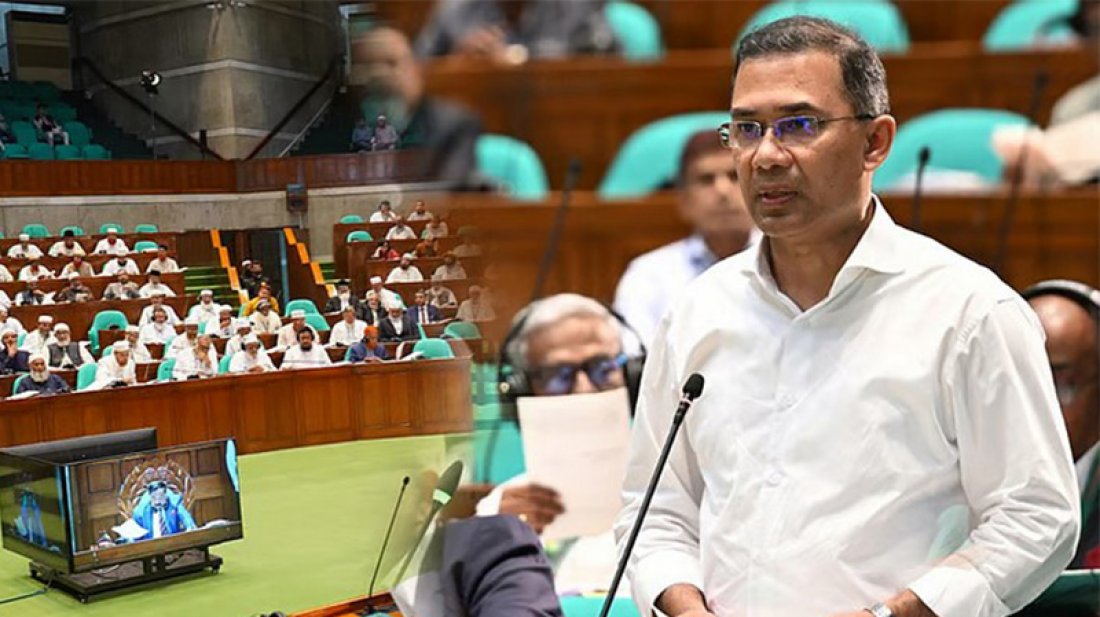
In an emotional and policy-oriented speech delivered at the concluding session of the Jatiya Sangsad, Prime Minister Tarique Rahman said, “The chair of the head of government may look very comfortable from a distance, but in reality, it is not comfortable at all. This chair is a very difficult place. When I sit in this chair, I feel every moment that the intense heat of fire is coming towards me.”
The prime minister made the remarks in his concluding speech during a discussion on the motion of thanks to the President’s address on Thursday (April 30), the final day of the first session of the 13th Jatiya Sangsad.
In his concluding remarks on the motion of thanks to the President, the prime minister shared his personal feelings about the chair he holds. He said, “This chair is a very difficult place. When I sit in this chair, I feel every moment that the intense heat of fire is coming towards me. As a politician, one may have opportunities to make popular statements in parliament or at public rallies and win applause, but this chair of responsibility does not allow that. This chair reminds me every moment that I have to take the right decision rather than the popular decision.”
The prime minister said, “The responsibility of meeting the expectations of the people and solving their problems increases the heat of this chair. If we chase popular decisions, we may receive applause, but in the long run, the country will suffer. That is why I urge members of parliament and friends in the opposition to discuss not popular decisions, but the right decisions.”
Referring to the country’s agricultural and environmental crises, Tarique Rahman said, “The problems of waterlogging and declining groundwater levels are extremely serious. The objective of reviving the historic canal-digging programme of Shaheed President Ziaur Rahman is to recharge groundwater levels. It will take around 20 years to see the positive results of this work. Therefore, keeping future generations in mind, we must prepare now for the challenging days ahead.”
On reforms in the education and health sectors, the prime minister said, “We are working to implement our election manifesto commitment to allocate around 5 percent of the total budget to the education sector. Alongside encouraging primary school children by providing them with bags, books and shoes, plans have been taken to increase the dignity of teachers so that they can focus on quality education. It is not enough to have hospital buildings; we must ensure doctors, necessary equipment and medicines there.”
Addressing the opposition leader, he said, “Our goal, objective and destination are the same—and that is to build a self-reliant and secure country for the people of Bangladesh.”
On preserving the dignity of parliamentary democracy, Prime Minister Tarique Rahman said, “Whenever democracy has been obstructed in the past, the country’s economy, healthcare system and employment have suffered. Recalling the 173-day hartal, he said that perhaps a government lost power at that time, but no one can honestly say that Bangladesh did not suffer. We are still paying the price for that damage.”
Highlighting the challenge of beginning to govern the country with a debt burden of Tk 30 lakh crore, he said, “If we cannot ensure a stable government and parliament, we will not be able to overcome this crisis.”
The prime minister expressed an accommodating attitude towards the opposition, saying, “The proposal to offer them the post of Deputy Speaker is still open, and I myself went to the residence of the opposition leader to seek cooperation.”
Highlighting employment for unemployed young people and losses suffered by farmers, the prime minister said, “Our valuable historical political debates will not fill the stomach of a hungry person or bring peace to the mind of the mother of a sick child. People now want solutions to their problems, not debates.”
Addressing opposition lawmakers, the prime minister said, “Your failure means my failure, and if any one of us fails, the whole of Bangladesh will fail. So, instead of competing with one another to make each other fail, let us work together to make this parliament successful.”
The head of government called on both sides to work shoulder to shoulder to develop every sector of the country, including the IT industry, with the aim of building a prosperous and self-reliant Bangladesh.