Kazi Sajidul Haque:
There has been considerable debate, both for and against, over the government campaigning in favour of the referendum. The government says that since there is no legal obstacle to taking a position, it can campaign for the “Yes” vote. That may be legally correct. There may indeed be no legal restriction. But what about the question of principle?
During the July-August mass uprising, various demands were raised. Eventually, those demands converged into a single-point demand. The Sheikh Hasina government was removed from power, and Sheikh Hasina fled to India. There is no need to recount what happened afterwards.
After the interim government was formed under the leadership of Dr Muhammad Yunus, we heard about reforms. We saw various initiatives. Many people from home and abroad became involved in the process. Several commissions were formed. Eventually, a National Consensus Commission was established to build consensus on the reform agenda.
Political parties put forward numerous discussions, demands and recommendations. The July National Charter was eventually prepared. The National Citizens Party (NCP), one of the government's major supporters, raised questions about the charter and did not sign it.
The government announced that both a parliamentary election and a referendum would be held. The government said it would campaign for the “Yes” vote. The Vice-Chairman of the National Consensus Commission was appointed to lead the campaign for the referendum.
The campaign is now underway. Meanwhile, the NCP has said it will appoint “ambassadors” in all 270 constituencies to campaign for a “Yes” vote in the referendum.
That is certainly an interesting initiative. Just as the NCP wants to place the mass uprising at the forefront, it also wants to give priority to the July Charter, which it itself did not sign.
Questions have also been raised about the role of returning officers in the government’s campaign.
Those who are supposed to play a neutral role in the parliamentary election will take a position in favour of one side in the referendum?
Abdul Alim, a member of the Electoral System Reform Commission and the National Election Investigation Commission, also spoke to the BBC about the matter. He believes that if deputy commissioners and upazila nirbahi officers (UNOs), who will serve as returning officers during the election, become involved in campaigning for the “Yes” vote, it could have an impact on the election.
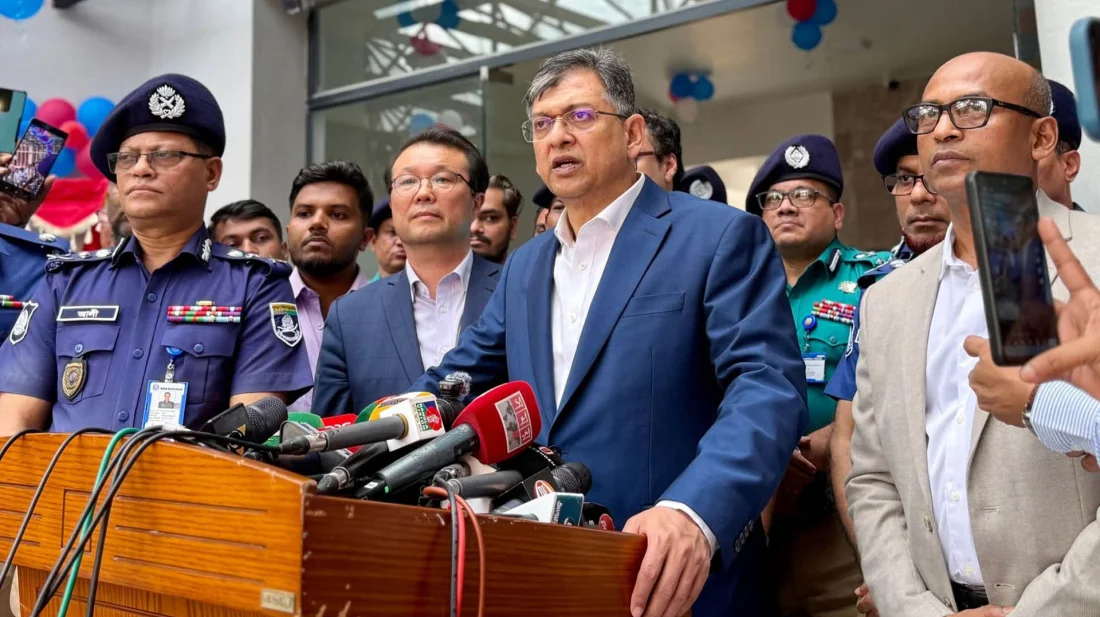
Chief Adviser’s Press Secretary Shafiqul Alam has said, “The government will campaign for the referendum because there is no legal obstacle.”
But the bigger question here is not the law. It is ethics. It is neutrality.
When a vote is held, if the result has effectively been predetermined, can it still truly be called a vote? And if the referee—the organiser of the vote—is himself taking one side, then the question becomes even more serious.
One could argue that this government is unlike other caretaker governments. This government is the product of a mass uprising. Therefore, the government will naturally support reforms. That is the central argument of the government’s position.
Although I will not raise here the question of what significant reforms have actually been made apart from changing the colour of police uniforms and renaming establishments.
What is a referendum? How many have been held in Bangladesh?
Bangladesh has previously held three referendums. And the country’s experience with referendums has not been particularly pleasant.
It has been seen that referendums were organised to obtain public legitimacy for the government’s position. In other words, the gun was placed on the people’s shoulders.
Bangladesh’s first referendum was held on May 30, 1977. It was intended to secure public support for the rule of military ruler Major General Ziaur Rahman.
The ballot asked voters:
“Do you have confidence in President Major General Ziaur Rahman (Bir Uttam) and in the policies and programmes adopted by him?”
According to official records, 88.1 percent of voters cast their ballots in that referendum. As many as 98.9 percent of those who voted expressed their support for President Zia’s rule.
Ershad followed Zia’s path
On March 21, 1985, General H M Ershad followed Zia’s path and organised a referendum to consolidate his political position and secure public support.
As in the first referendum, voters were presented with a question concerning their confidence in the ruler.
The ballot contained two parts.
The first asked:
“Do you have confidence in President Lieutenant General Hussain Muhammad Ershad and in the policies adopted by him?”
The second part asked:
“Do you want President Ershad to administer the country until he hands over power to an elected government through a national election?”
According to official figures, voter turnout in the 1985 referendum was 72.2 percent. Of those who participated, 94.5 percent expressed their support for Ershad.
A year after the referendum, in 1986, Ershad held a parliamentary election.
Government campaign for ‘Yes’ vote raises questions over neutrality
In July 1991, the 12th Amendment to the Constitution was unanimously passed by Parliament. Through the amendment, Bangladesh returned to a parliamentary system.
The 11th Amendment had validated Shahabuddin Ahmed’s return to the position of Chief Justice after serving as acting president. The third—and so far the last—referendum in the country’s history was held on whether the president should give his assent to the 12th Amendment Bill.
The referendum was held on September 15, 1991. Voters were asked:
“Should the President give his assent to the Constitution (Twelfth Amendment) Bill?”
So, of the three referendums held in Bangladesh, two effectively produced an outcome in favour of the government—or, more precisely, the head of government.
Those who voted were, in effect, saying: “Yes, brother, we agree with the government.”
However, there is a significant difference between those referendums and the one being proposed now.
The previous referendums concerned a specific question. This time, that is not the case.
This time, multiple issues are being put together under a single “Yes” or “No” choice. There is no opportunity to agree with one issue and disagree with another.
And we know from the very recent past what problems can arise when everyone is expected to be in agreement.
Yet the government is campaigning in favour of the “Yes” vote.
Let us look at the matter from another angle.
The government supports the “Yes” vote. That means it is against the “No” vote.
What happens to those who disregard the government’s position and vote “No”? Will they be labelled anti-government or anti-state? Will they be punished?
A few days ago, there were incidents of mob violence at Prothom Alo and The Daily Star. There had been similar attempts before.
When questions were raised about those incidents, Shafiqul Alam—the Chief Adviser’s press secretary, although in practice he functions primarily as the government’s spokesperson—said they were not mobs but “pressure groups”.
But after attacks, arson and looting at the country’s two leading newspapers, he said he felt “ashamed”.
If questions are raised in the future about the legitimacy of the referendum, or if a legal dispute arises over the referendum process, who will feel ashamed then?
[Kazi Sajidul Haque]
The author is a journalist.
Government Campaigning for ‘Yes’ Vote Raises Questions Over Neutrality

Read More